Why Are We So Amazed by Robots?

People have been talking about robots longer than robots have existed.
Long before metal arms and blinking sensors, humans imagined artificial beings in myths, legends, and early science fiction. From ancient automata described by Greek engineers, to golems in Jewish folklore, to mechanical men in early 20th-century stories, the idea of a constructed “other” has been with us for centuries. We gave it names, personalities, fears, and hopes long before we gave it motors and code.
That long prehistory matters. Robots didn’t enter our imagination as tools. They entered it as beings.
That may be why robots still feel mysterious in a way few other technologies do. We are not just amazed by what robots can do—we are unsettled by what they seem to be. A robot looks like intention without life, action without consciousness. It occupies an uncomfortable middle ground: not alive, not dead, not human, not object. We instinctively project meaning onto movement, agency onto automation. Even the simplest robot invites questions we never ask of a hammer or a calculator.
This is also why robots generate disproportionate hype—and disappointment.
Despite decades of breakthroughs, real-world robot adoption remains surprisingly low. Outside of factories, warehouses, and a handful of specialized domains, robots are still rare. They don’t clean our homes reliably, care for the elderly at scale, or coexist naturally in public spaces. The gap between expectation and reality is vast.
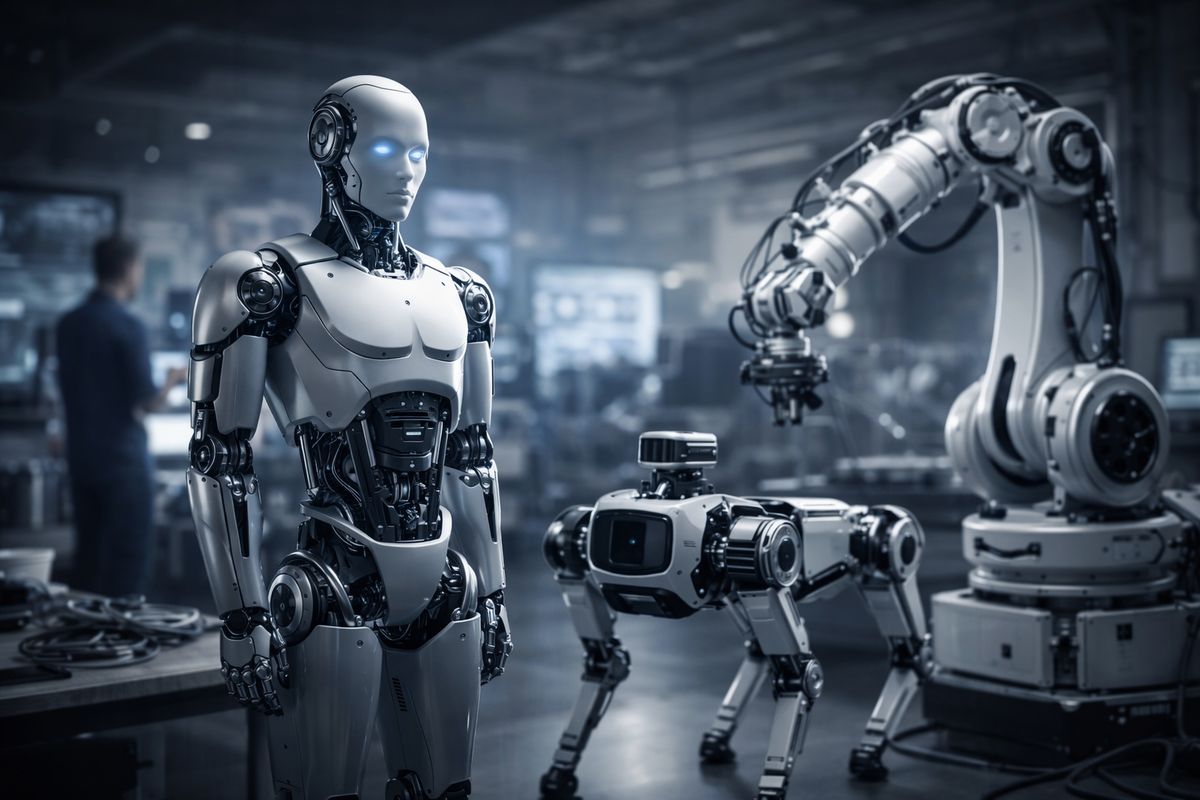
Part of the problem is technical, but much of it is conceptual. We keep trying to make robots impressive instead of useful. We optimize for spectacle—humanoid faces, viral demos, novelty behaviors—rather than boring reliability. We ask robots to imitate humans instead of complementing them. And when they fail to live up to cinematic expectations, we quietly move on to the next demo.
In many cases, we are not using robots anywhere near their potential. We turn them into toys, companions, or entertainment devices because those are emotionally satisfying narratives. But the real value of robotics is not in pretending machines are human—it’s in allowing humans to stop doing what machines are better suited for.
The most transformative robots of the future will likely not look like us at all.
They will be systems that disappear into infrastructure: maintaining power grids, inspecting bridges, cleaning oceans, managing agriculture, responding to disasters, operating in environments that are dangerous, monotonous, or inaccessible to humans. They will extend human reach rather than mimic human form. When they succeed, they won’t amaze us. They will quietly fade into the background, like electricity or plumbing.
And that may be the final irony.
We are amazed by robots because they feel like a mirror—reflecting our desire to create, to control, to replicate ourselves. But the moment robots truly fulfill their purpose, they may stop feeling magical altogether. They will become part of the environment, not the story.
Perhaps robots are not here to replace us, entertain us, or impress us.
Perhaps they are here to teach us something uncomfortable: that intelligence, agency, and value do not always look the way we expect—and that the future is often less dramatic, and more profound, than our imagination allows.