Why Living on Mars Is Probably Not a Good Idea for Humanity

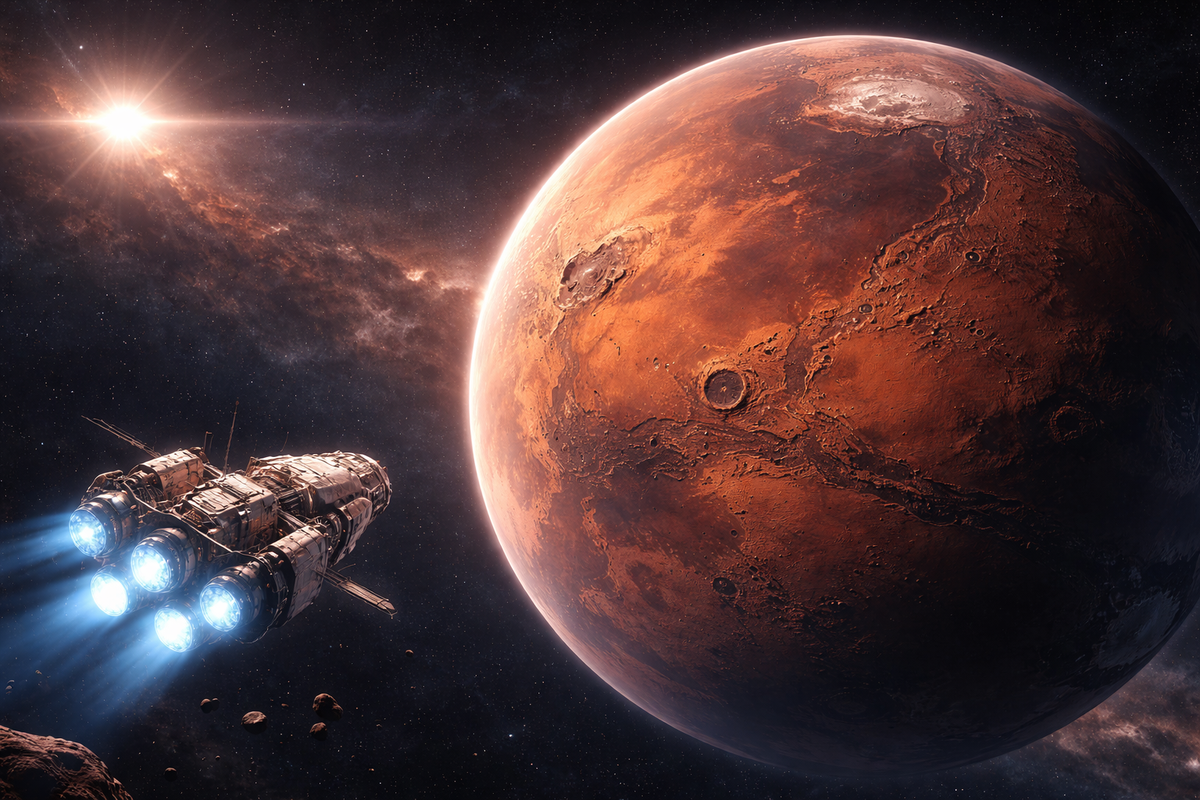
Mars has become a symbol.
Not just of exploration, but of escape.
In recent years, the idea of humans living on Mars has shifted from science fiction into something that sounds almost… inevitable. We talk about Martian cities, permanent settlements, and becoming a “multi-planetary species” as if the question is when, not whether. But beneath the excitement, there’s an uncomfortable possibility we rarely examine:
What if living on Mars is simply not a good idea—for humans?
Mars as a destination vs. Mars as a system
From an engineering perspective, reaching Mars is an extraordinary achievement. Establishing robotic outposts, research stations, and automated infrastructure there makes sense. Mars is a natural laboratory: a place to study planetary formation, climate evolution, and the limits of life.
But human permanence is a very different proposition.
Mars is not hostile in the way a jungle or a desert is hostile. It is hostile in a way that biology itself struggles to negotiate. Thin atmosphere. Intense radiation. Reduced gravity. Extreme cold. Toxic soil. No magnetic field. Every breath, every drop of water, every calorie must be engineered.
A Mars “habitat” would not be a place to live—it would be a place to survive.
Humans are not evolved for sealed systems where failure means instant death. Long-term exposure to low gravity alone raises unanswered questions about bone density, muscle function, cardiovascular health, reproduction, and development. Add psychological isolation, limited medical options, and the impossibility of rapid evacuation, and the picture becomes less heroic and more precarious.
We could send humans to Mars.
That does not mean we should expect them to live there.
Why would we even want to live there?
When people argue for Mars settlement, the motivations usually fall into a few categories:
- Backup plan for humanity
- Resource extraction
- Scientific advancement
- Technological inspiration
The problem is that Mars is a poor solution to all four.
As a backup for humanity, Mars is fragile. A Mars colony would depend entirely on Earth for technology, knowledge, and often supplies. A planet that cannot sustain human life independently is not a true lifeboat—it’s an outpost.
As a source of resources, Mars is deeply inefficient. Transporting materials across interplanetary distances costs enormous energy. Anything valuable enough to justify that effort would need to be uniquely irreplaceable, and so far, Mars offers nothing that Earth, near-Earth asteroids, or orbital infrastructure couldn’t provide more safely and cheaply.
As a scientific platform, robots already outperform humans in most Martian tasks. They don’t need air, food, gravity, or return tickets. AI-driven exploration can operate continuously, scale faster, and fail without ethical consequences.
And as inspiration? That’s a cultural argument, not a survival one.
The romance of escape
Mars carries a deeper emotional appeal. It represents a clean slate. A second chance. A world without history, politics, or ecological damage.
But that romance can be misleading.
If we struggle to manage a planet that already has air, water, biodiversity, and a stable biosphere, what makes us think we’ll do better on a planet that has none of those things?
Mars doesn’t remove our problems—it magnifies them.
Every issue we face on Earth—resource allocation, inequality, governance, environmental stability—becomes more acute when survival margins are razor thin. There is no “away” on Mars. No redundancy without cost. No mistakes without consequences.
A better question to ask
Instead of asking, “How soon can humans live on Mars?”, a more honest question might be:
What kind of future are we avoiding by wanting to leave Earth?
Earth is not just habitable—it is extraordinarily forgiving. It absorbs mistakes. It regenerates. It supports complexity at scale. There is no known alternative that comes even close.
The technologies we imagine for Mars—closed-loop life support, sustainable energy systems, advanced automation, climate control—are exactly the technologies we need here. Perfecting them on Earth would improve billions of lives. Perfecting them for a few thousand people on Mars would mostly prove that we can survive under extreme constraints.
Mars has a role—just not the one we imagine
None of this means Mars exploration is pointless. Mars matters. It should be studied, explored, mapped, and understood. It should host robots, experiments, and maybe temporary human missions.
But treating Mars as humanity’s next home may say more about our discomfort with Earth than our readiness for the stars.
The future of human progress is not about abandoning the only planet that already works. It’s about learning how to live well within one.
Mars can wait.
Earth cannot.